






Deep Plane Facelift Before and After: Realistic Results | Dr. Altan Tekin
Discover realistic deep plane facelift before and after results. Learn what changes to expect, recovery timelines and how to choose a facelift surgeon in Antalya, Turkey.
Dr. Altan Tekin
10/31/202610 min read


Deep Plane Facelift Before and After: What Results Can You Realistically Expect?
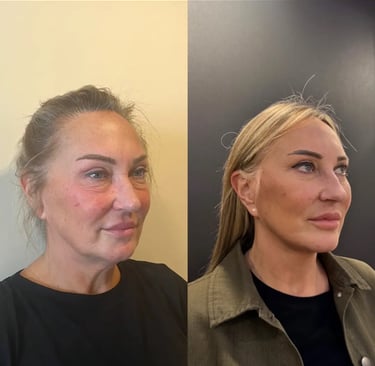
Choosing to undergo a facelift is a significant personal decision. If you have been researching deep plane facelift before and after photos, you have probably noticed how dramatically facial appearance can change following surgery.
But what makes a deep plane facelift different? Can it restore a youthful jawline, improve sagging cheeks and reduce the appearance of deep facial folds? How long does it take to see the final results?
For patients considering a Deep Plane Facelift in Antalya, Turkey, understanding realistic surgical outcomes is just as important as choosing the right procedure and surgeon.
At the clinic of Op. Dr. Altan Tekin, Plastic, Aesthetic and Reconstructive Surgeon in Antalya, facial rejuvenation is approached with an emphasis on individual facial anatomy, natural-looking outcomes and personalised surgical planning.
In this guide, we explain what you can realistically expect from deep plane facelift surgery, which facial areas may improve, how results develop over time and what to consider when comparing before and after photographs.
What Is a Deep Plane Facelift?
A Deep Plane Facelift is an advanced facial rejuvenation technique that focuses on repositioning deeper facial tissues rather than simply tightening the skin.
The procedure works beneath the superficial musculoaponeurotic system (SMAS), releasing selected retaining ligaments and allowing the deeper facial tissues to be repositioned.
This approach aims to address several signs of facial ageing, including:
Sagging cheeks and midface descent.
Deepening nasolabial folds (lines between the nose and mouth).
Jowls along the lower jawline.
Loss of definition around the lower face.
Selected signs of ageing around the jawline and neck.
Unlike approaches that rely primarily on skin tightening, deep plane techniques focus on repositioning underlying tissues to create a more balanced facial appearance.
However, the most appropriate facelift technique depends on the patient's anatomy, degree of tissue laxity, skin quality and individual expectations.
Deep Plane Facelift Before and After: What Changes Can You Expect?
One of the most frequently searched questions online is:
"What does a deep plane facelift actually look like before and after surgery?"
The answer depends on the areas being treated and the patient's individual facial characteristics.
The purpose of a well-planned facelift is not to create a completely different face. It is to improve selected signs of ageing while maintaining the patient's natural facial identity.
Here are some of the changes that may be visible following surgery.
1. More Defined Jawline and Reduced Jowls
One of the most noticeable improvements after a facelift can be the definition of the lower face.
As facial tissues descend with age, soft tissue may accumulate along the jawline, creating jowls and reducing the distinction between the face and neck.
A deep plane facelift may help:
Reposition descended facial tissues.
Improve jawline definition.
Reduce the appearance of jowls.
Restore a smoother transition between the lower cheek and jawline.
The extent of improvement depends on the patient's anatomy and the surgical plan.
2. Improved Midface Contours and Cheek Position
Ageing affects more than the skin. Changes in the position and volume of deeper facial tissues can contribute to a tired or less defined appearance.
A deep plane facelift may improve the position of descended cheek tissues, helping restore a more youthful midface contour.
Potential improvements include:
Better-defined cheek contours.
Reduced appearance of midface sagging.
Softer nasolabial folds in suitable patients.
A more balanced transition between the cheeks and lower face.
It is important to understand that deep folds may not disappear completely. Their appearance is influenced by several factors, including skin quality, facial volume and individual anatomy.
3. A More Refreshed and Natural Facial Appearance
Many patients researching facelift surgery are concerned about looking unnatural or overly tight after surgery.
A carefully planned deep plane facelift aims to reposition facial tissues rather than create an artificial pulled appearance.
The objective is to maintain:
Natural facial proportions.
Individual facial characteristics.
Balanced facial contours.
Natural-looking expression and movement.
No surgical technique can guarantee a particular aesthetic result. The surgeon's assessment, surgical approach and healing process all influence the final outcome.
4. Better Jawline and Neck Definition
Facial ageing frequently involves both the lower face and the neck.
Some patients experience jowls alongside loose neck skin, visible platysmal bands or reduced definition between the chin and neck.
In these situations, a facelift may be considered alongside a neck lift.
Depending on the patient's anatomy, combined facial and neck rejuvenation may address:
Loose skin around the neck.
Selected platysmal muscle changes.
Reduced definition of the cervicomental angle.
Age-related changes beneath the chin.
Loss of definition along the jawline.
Not every patient requires a separate neck lift. The appropriate approach is determined following an individual examination.
How Long Does It Take to See Deep Plane Facelift Results?
A common misunderstanding is that the result visible immediately after surgery represents the final outcome.
In reality, facial tissues need time to heal, swelling needs to settle and the skin and underlying structures gradually adapt to their new position.
The following timeline provides a general overview.
Deep Plane Facelift Recovery Timeline
Days 1–7: Early recovery
Swelling, bruising, tightness and temporary changes in sensation are common. Rest and post-operative monitoring are important.
Weeks 2–3: Initial visible improvement
Bruising and swelling generally begin to improve. Many patients become more comfortable with social activities, although healing is still ongoing.
Weeks 4–6: Facial contours continue to settle
Swelling gradually decreases, and the facial appearance becomes more settled. Activity should be resumed according to the surgeon's instructions.
Months 3–6: Further refinement
Facial tissues continue to heal, and the result becomes more representative of the longer-term outcome.
Months 6–12: Scar and tissue maturation
Scars and residual tissue changes may continue to mature. Individual healing times vary.
This is an illustrative timeline, not a guaranteed recovery schedule. Your surgeon's instructions take priority.
The NHS explains that the full effect of facelift surgery may take approximately 6–9 months to become apparent. Individual recovery following deep plane surgery can vary.
Deep Plane Facelift Before and After: Why Do Results Differ Between Patients?
When comparing deep plane facelift photos, it is important to remember that no two faces age in exactly the same way.
Even when two patients undergo similar procedures, their outcomes may differ.
Several factors influence the final result.
Age and Facial Anatomy
Age alone does not determine whether someone is suitable for surgery.
The position of the facial tissues, skin elasticity, fat distribution and degree of tissue descent are more important considerations during surgical planning.
Skin Quality
Skin thickness, elasticity, sun damage and existing skin conditions can influence healing and the appearance of the final result.
Facial Volume
Some patients have significant tissue descent, while others have experienced facial volume loss.
Depending on the assessment, additional procedures such as fat transfer may be considered. These are not necessary for everyone.
Surgical Planning and Technique
The surgical approach must be adapted to the patient's facial anatomy.
An experienced plastic surgeon should explain which areas can realistically improve, which limitations remain and whether a deep plane facelift is the most suitable technique.
Lifestyle and Healing
Smoking, certain medical conditions, medications and individual healing characteristics can affect surgical recovery.
Patients should discuss their medical history and lifestyle openly with their surgeon before proceeding.
Deep Plane Facelift Before and After Photos: What Should You Look For?
Before and after photographs can be a valuable part of researching facelift surgery.
However, it is important to evaluate them carefully rather than focusing exclusively on dramatic transformations.
When reviewing photographs, consider the following:
1. Consistent photography conditions
Ideally, photographs should be taken with similar lighting, camera distance, facial expression and head position.
2. Multiple viewing angles
Front, oblique and side-profile photographs can provide a more complete understanding of facial changes.
3. Appropriate follow-up period
Photographs taken shortly after surgery may show swelling and bruising. Longer-term photographs provide a more useful assessment of the healed result.
4. Similar starting characteristics
Comparing patients with similar facial anatomy and ageing patterns may help you understand which outcomes are relevant to your own expectations.
5. Authentic patient photographs
Look for genuine clinical photographs used with the patient's informed consent. Images should not be misleadingly edited or presented as guaranteed outcomes.
At Op. Dr. Altan Tekin's clinic, prospective patients should be encouraged to discuss relevant clinical examples during their consultation and understand the limitations of photographic comparisons.
Is a Deep Plane Facelift Better Than a Traditional Facelift?
There is no single facelift technique that is automatically best for every patient.
A deep plane facelift focuses on repositioning deeper facial tissues, whereas other facelift techniques may involve different combinations of SMAS manipulation, skin elevation and tissue tightening.
The most appropriate technique depends on:
The patient's facial anatomy.
The degree and location of facial ageing.
Skin quality and tissue laxity.
The surgeon's clinical assessment.
The patient's expectations.
The goal should not be to choose the most fashionable technique. It should be to select the most appropriate surgical approach for the individual patient.
How Long Do Deep Plane Facelift Results Last?
A deep plane facelift can provide long-lasting facial rejuvenation, but it does not stop the natural ageing process.
The face continues to change over time due to genetics, gravity, skin quality, lifestyle and other factors.
Following surgery, patients continue to age, but the improvement achieved through surgery may remain visible for many years.
It is therefore important to think of facelift surgery as repositioning the ageing process rather than permanently stopping it.
No surgeon can accurately guarantee how long an individual patient's results will last.
Why Consider Deep Plane Facelift Surgery in Antalya, Turkey?
For patients travelling from the United Kingdom, choosing a surgeon abroad requires careful research.
Antalya is an established international destination, but the location alone should never determine your choice of surgeon.
Before deciding to undergo facelift surgery in Turkey, consider the following:
1. Check Your Surgeon's Qualifications
Confirm the surgeon's specialist qualifications, professional registration, surgical experience and specific experience with facelift procedures.
2. Understand Where Your Surgery Will Take Place
Ask about the hospital or surgical facility, anaesthesia arrangements, emergency support and post-operative monitoring.
3. Ask About Your Aftercare Plan
Your treatment plan should include clear arrangements for follow-up appointments, wound checks, complication management and communication after returning to the UK.
4. Allow Enough Time in Antalya
International patients should not organise their return flight around a fixed holiday schedule.
The timing of air travel must be determined by the operating surgeon after considering the procedure, recovery progress and individual risk factors.
5. Understand the Entire Treatment Plan
Before booking, make sure you understand what is included, what additional costs may apply and how you will receive medical support after returning home.
These considerations are particularly important for patients travelling internationally for elective surgery.
Deep Plane Facelift in Antalya with Op. Dr. Altan Tekin
Op. Dr. Altan Tekin is a Plastic, Aesthetic and Reconstructive Surgeon based in Antalya, Turkey.
His practice includes facial rejuvenation procedures, including facelift and neck lift surgery, with treatment planning based on individual facial anatomy and patient expectations.
For patients considering a deep plane facelift, the consultation process should address:
The areas of facial ageing that concern the patient.
Whether a deep plane facelift is appropriate.
Whether a neck lift or another complementary procedure may be beneficial.
Expected improvements and surgical limitations.
Potential complications and recovery requirements.
The arrangements required for international patients.
The aim is to develop an individualised surgical plan rather than recommend the same operation to every patient.
If you are considering travelling from the UK for facial rejuvenation, an initial online consultation can help establish whether further assessment may be appropriate.
Explore the procedure: Deep Plane Facelift in Antalya, Turkey
Frequently Asked Questions About Deep Plane Facelift Before and After
How long does it take to see the final results of a deep plane facelift?
Initial improvements become visible as swelling and bruising decrease. However, the face continues to heal over several months. A more mature result may take 6–12 months, depending on individual healing.
Will I look different after a deep plane facelift?
The aim is to improve signs of facial ageing while preserving your individual appearance. The degree of change depends on your anatomy and surgical plan.
Does a deep plane facelift remove nasolabial folds?
It may soften the appearance of nasolabial folds by repositioning descended midface tissues. However, complete elimination cannot be guaranteed.
Does a deep plane facelift improve the neck?
It can improve selected aspects of lower-face and neck contour. Patients with additional neck concerns may benefit from a combined neck lift, depending on their anatomy.
Are deep plane facelift before and after photos reliable?
They can be helpful when they are genuine, taken under consistent conditions and show an appropriate follow-up period. Photographs should never be interpreted as a guarantee of your own results.
How long do deep plane facelift results last?
The results can remain noticeable for many years. However, natural ageing continues, and longevity varies between individuals.
Can I travel from the UK to Antalya for a deep plane facelift?
Yes, international patients can seek treatment in Antalya. However, surgery should only be planned after appropriate medical assessment. Your return flight should be scheduled according to your surgeon's advice, not simply according to a predetermined travel package.
How do I choose a deep plane facelift surgeon in Antalya?
Check specialist qualifications, relevant surgical experience, hospital arrangements, genuine patient photographs, complication management and long-term aftercare. A detailed consultation should include an honest discussion of potential benefits and risks.
Book Your Deep Plane Facelift Consultation in Antalya
If you are researching deep plane facelift before and after results and considering facial rejuvenation in Turkey, the first step is understanding which procedure is appropriate for your individual needs.
At Op. Dr. Altan Tekin's clinic in Antalya, prospective patients can discuss their facial concerns, treatment options, expected outcomes and recovery requirements through an individual consultation.
Whether you are travelling from London, Manchester, Birmingham or elsewhere in the United Kingdom, your surgical journey should begin with a thorough medical assessment and realistic expectations.
Contact Op. Dr. Altan Tekin to discuss Deep Plane Facelift surgery in Antalya, Turkey.




Address
Çelikoğlu Sitesi, B Block, 1st Floor, Apartment 3, 1546th Street, Şirinyalı, Muratpaşa, Antalya 07160, Türkiye
DR. ALTAN TEKIN
Op. Dr. Altan Tekin is a board-certified Plastic, Aesthetic and Reconstructive Surgeon in Antalya, Turkey.
Particular attention is given to patients seeking facelift surgery, body contouring after significant weight loss, and mommy makeover surgery.

